

Is Conservation a Religion?
Hear me out.

Last month, Liz Bucar of Religion, Reimagined wrote a viral essay called “What If Trevor Noah Is Right About the Left and Religion?” In it, she considers an exchange between Trevor Noah and Zohran Mamdani, New York City’s mayor, during a December 2025 interview.
After noting that Republicans have been “pretty good at imagining and hoping” in recent years, Noah wondered if the Democrats’ relative lack of vision could be partly explained by “the decline of religion on the left.” In the subsequent discussion, Noah observed:
[O]ne of the things that faith requires of you is an ability to believe that this current state that you are in is not the end. There is a possibility that something can be greater. And even though you cannot see it, you believe that it can happen.
Mamdani agreed, adding that during his mayoral campaign, he saw that “it’s often in houses of worship where New Yorkers still have that trust, still have that faith. And it’s by and large lost when it comes to politics.”
In her essay, Bucar likens Noah’s description of faith to Catholic theologian David Tracy’s concept of the “analogical imagination.” Religious traditions, Tracy argues, teach people to pay “disciplined attention to what reality itself suggests is possible” — or, as Bucar puts it, “how to look at the world as it is and simultaneously hold in their minds what it could become,” establishing among their adherents a “costly, sustained trust” in the possibility of a better future.
Bucar wonders how those without religious traditions learn the kind of disciplined attention that leads them to trust in possibility. “What gives you practice believing transformation is possible when every piece of evidence says otherwise?” Bucar concludes. “I genuinely don’t know.”
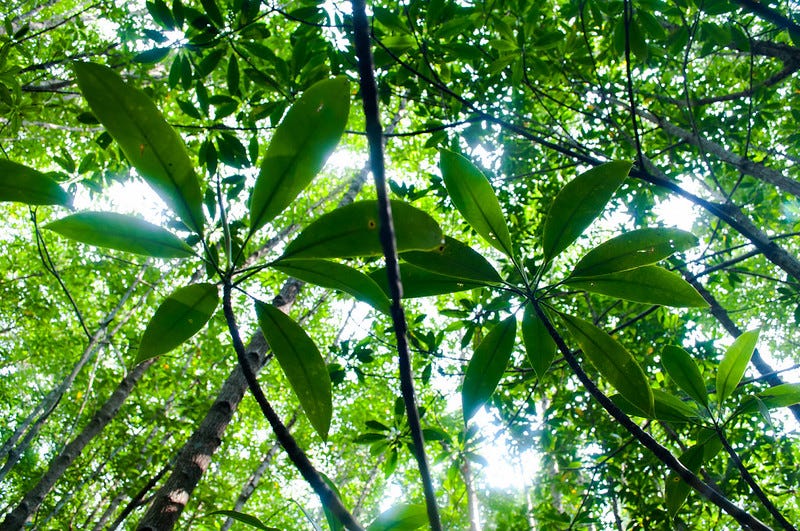
When I first read this essay, I thought, oh, I know! Or, at least, I know how I cultivate my belief in transformation: by observing the living world.
The sight of a mushroom busting through the leaf litter is a good cure for despair, I find; so is my teenager, who gains wisdom every week (and won’t appreciate being compared to a mushroom, but it’s a compliment, I promise).
The living world also shows us that our species, despite its faults, can bring about positive transformations. The recent removal of four dams from the Klamath River in southern Oregon and northern California has led to a speedy recovery of the river’s salmon; reintroductions in the Western U.S. have led to politically fraught but ecologically significant recoveries of wolves and bison.
Believing that salmon like free-flowing rivers is, I’ll admit, a lot easier than believing that the current global slide toward authoritarianism will one day reverse course. That’s where Tracy’s “analogical imagination” comes in. Paying attention to the transformative potential of fish, or rivers, helps me imagine analogous transformations in politics and human societies (and almost keep a straight face while doing so). I don’t have faith that such transformations will happen, but I do have faith that they can happen, and that goes a long way toward getting me out of bed in the morning. Call it a religion, if you like; in these times, I call it a means of survival.
Earlier this week, Jeremy Hance of Mongabay published a distressing but important story about the mental health of conservation practitioners, documenting what conservationist and physician Vik Mohan describes as a “growing epidemic of suffering” in the field. “Twenty years ago, you came into conservation with a much greater sense of optimism,” Mohan says, “whereas now, you cannot escape the urgency and the enormity of the crisis.”
It’s one thing for me, in my relatively comfortable surroundings, to cultivate my analogical imagination. It’s quite another for those on the front lines of conservation, many of whom regularly suffer the losses of beloved places, species, and even colleagues while enduring difficult conditions and low pay.
These conservationists need more material support, Mohan emphasizes, and professional cultures that encourage them to work to their capacity instead of attempting, at their peril, to meet the (unending) need. But he suggests that they, too, can find solace and inspiration in the living world they strive to protect, difficult though its potential can sometimes be to discern. “Perhaps the most important message,” says Mohan, “is that change is possible.”
Conservation at Work
I was happy to see the Lonely Conservationists (whose motto is “But together, we aren’t so lonely anymore!”) featured in Hance’s Mongabay article. Founded by Australian ecologist Jessie Panazzolo in 2019, the group is a wonderful source of support for conservation practitioners.
Over the past several months, I’ve spoken with dozens of conservationists whose careers, lives, and crucial projects were disrupted by the Trump administration’s abrupt and chaotic dismantling of the U.S. Agency for International Development in early 2025. That reporting resulted in “The Future of Conservation Without U.S. Aid,” part of a package of stories published by bioGraphic last week. Thanks to my excellent editor Krista Langlois and her colleagues for all their support.
I’ve previously written about conservation biologist Kent Redford and his call for the conservation of microbial communities; a new essay by Redford, published in Oryx, advocates a “three-stranded” approach to conservation that improves on what’s already working; extends existing efforts to achieve new and better conservation results; and develops novel tools ranging from synthetic biology techniques to methods of calculating future conservation value. “[P]erched at the trailing edge of the Holocene, oppressed by the triple assaults of biodiversity loss, climate change, and pollution,” Redford writes, “we are looking for hope from the powerful creativity and passion that fuels the conservation movement.”
I was going to write about the “evidence problem” in conservation — the subject of an editorial in Nature last month — but Mongabay founder Rhett Ayers Butler beat me to it, so I’ll send you to his commentary instead. (Suffice to say that rather than an evidence problem or an “evidence emergency” — another term invoked by Nature — I see an already well-established field of research that deserves a lot more support.) I’ll also second Butler’s recommendation of this piece by Tanya O’Garra, chair of the Society for Conservation Biology’s Impact Evaluation Working Group, which makes a persuasive case for counterfactual studies as a means of documenting causes and effects in conservation.
Finally, chag Purim sameach to those who celebrate! Baking renews my faith in transformation, too — especially when it leads to apricot hamantaschen.

Great piece, though I fear it only scratches the surface of the answer. Please keep writing about this!
Indeed. The wisdom of the living world is ancient and abundant! May we learn to see.