

More Than a Conversation
The National Wolf Conversation was a glimpse of a better future.

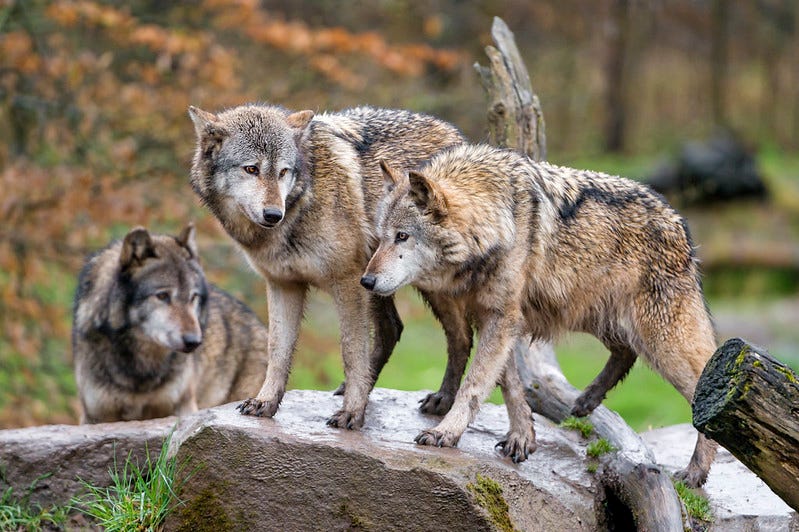
In January, I was one of 25 participants in an event called the National Wolf Conversation, which took place over three days in Tucson, Arizona. Convened by Constructive Conflict, an independent consultancy hired by the U.S. Fish and Wildlife Service, the conversation was originally intended to involve several extended meetings over 18 months, but funding cuts put a stop—a temporary stop, at least—to the process almost before it started.
The three days we got, however, were remarkable. I’ve written about them here and here, and now you can hear directly from each participant in these short before-and-after interviews recorded by filmmaker Jared Callahan. The participants were chosen by Constructive Conflict to represent a wide range of experiences with and positions on the recovery of wolves in the U.S., so everyone who came to Tucson knew they would have fundamental differences with at least some of the other participants. Many of them, as you’ll see in the interviews, were skeptical at the start; they’d sat down with adversaries before, and come away feeling like they’d wasted their time.
I was skeptical, too. Over the years, I’ve observed plenty of roundtables, dialogues, and councils intended to resolve deep-seated disputes over wildlife, and only rarely have I seen them produce anything but frustration.
The National Wolf Conversation was different, though. I’m still trying to figure out exactly why, but one important difference was that we got to know one another as people before we even started talking about wolves: We were asked not to share our last names or professions, or to reveal our positions on wolf recovery, until we had spent most of a day together. By the time we fully introduced ourselves, we’d established enough goodwill that our differences, though deep as ever, generated more curiosity than antagonism. During the rest of our time in Tucson, I saw that curiosity serve us again and again, drawing us together instead of driving us apart.
Another difference was that the conveners didn’t hold us to a fixed agenda. Specialists in conflict transformation, they observed the group closely and responded to what they saw, nudging us toward difficult issues and then, as tensions arose, introducing a question or an exercise designed to remind us of what we had in common. Some of their interventions were so subtle that only in retrospect did I realize they had intervened at all.
Finally, the participants in the National Wolf Conversation weren’t seeking consensus, or compromise. We certainly weren’t trying to craft new policies, not in three short days. What we were doing, as I think you’ll see in the videos, was shifting and expanding our own perspectives.
If we came in thinking that all environmentalists hated ranchers, or that all ranchers were rich guys who had it out for wildlife, or that the idea of wolves themselves having a voice in the conversation was ridiculous, or that conflicts between livestock producers and wolves could be easily solved with better fences or fiercer guard dogs or more vegetarianism, we were thinking again. We were being reminded of the realities behind every stereotype, and recognizing the costs of polarized conflict to all involved, wolves included. We were forming the kind of relationships that could, eventually, lead to lasting solutions.
These might sound like platitudes, and maybe they are, but the conversation in Tucson was anything but. It was complicated, fascinating, frustrating, sometimes hilarious, and immensely rewarding. I hope it will continue.
Conservation at Work
Earlier this year, I wrote about the many meanings of “coexistence”; in this insightful Undark essay, wildlife biologist Ashraf Shaikh warns that the term can be “used to justify state apathy, erase community suffering, and treat cultural endurance as a substitute for institutional support.” Just coexistence is possible, he writes, but the concept “must be reclaimed, not romanticized.”
Recent Republican proposals to sell large chunks of U.S. public land have been beaten back, thanks in part to bipartisan public opposition, but supporters of public lands must keep arguing for their protection. This article from the Regulatory Review focuses on the Conservation and Landscape Health Rule—which was developed by the Bureau of Land Management under the Biden administration and is now very likely to die a premature death—but it makes a persuasive general case for conservation as a valuable “use” of public lands.
Speaking of public lands, check out Next Interior Memos, the newsletter of the new group Next Interior. Founded by Jacob Malcom, who directed the Office of Policy Management at Interior before resigning in protest earlier this year, Next Interior aims to expand public support for the department’s mission—and its current, former, and future employees.
One encouraging indicator of that support: the Trump administration’s request that national park visitors report “negative” portrayals of U.S. history by the National Park Service has instead triggered an avalanche of scathing (and darkly funny) comments about the administration itself. “I’ve noticed that they’re aren’t nearly enough signs about how a tyrannical government is trying to whitewash history,” one park visitor wrote. To learn more about the history of history in the national parks, check out “Protecting History in the Parks,” a recent essay from Adam Sowards of Taking Bearings.
This Farm Aid webinar on rural mental health is a powerful reminder that conservation depends on the wellbeing of those who live closest to the land.
My essay “Saving Graces,” published in the latest issue of the New York Review of Books, features three books about saving things—from species and habitats to specimens, traditions, and personal treasures. Readers of Conservation Works may be especially interested in What to Save and Why by philosophy professor Erich Hatala Matthes, a pithy and practical examination of the big questions common to all kinds of conservation.
Finally, this short film, which maps the path taken by a whooping-crane family on its migration from Texas to Alberta in spring of 2022, is worth six minutes of your time. Extraordinary conservation efforts have so far protected whoopers from extinction, but their migratory paths are narrowing and filled with threats; it’s both exhilarating and sobering to get a glimpse of the journey from their perspective.
Thanks, especially for the Whoopers little film. I was staggered to see how narrow their feasible path is these days.
This documents some conversations a while ago: https://www.csmonitor.com/layout/set/amphtml/1995/0619/19191.html