

Wake Up and Fight (Again)
Woody Guthrie and the importance of clarity in bad times

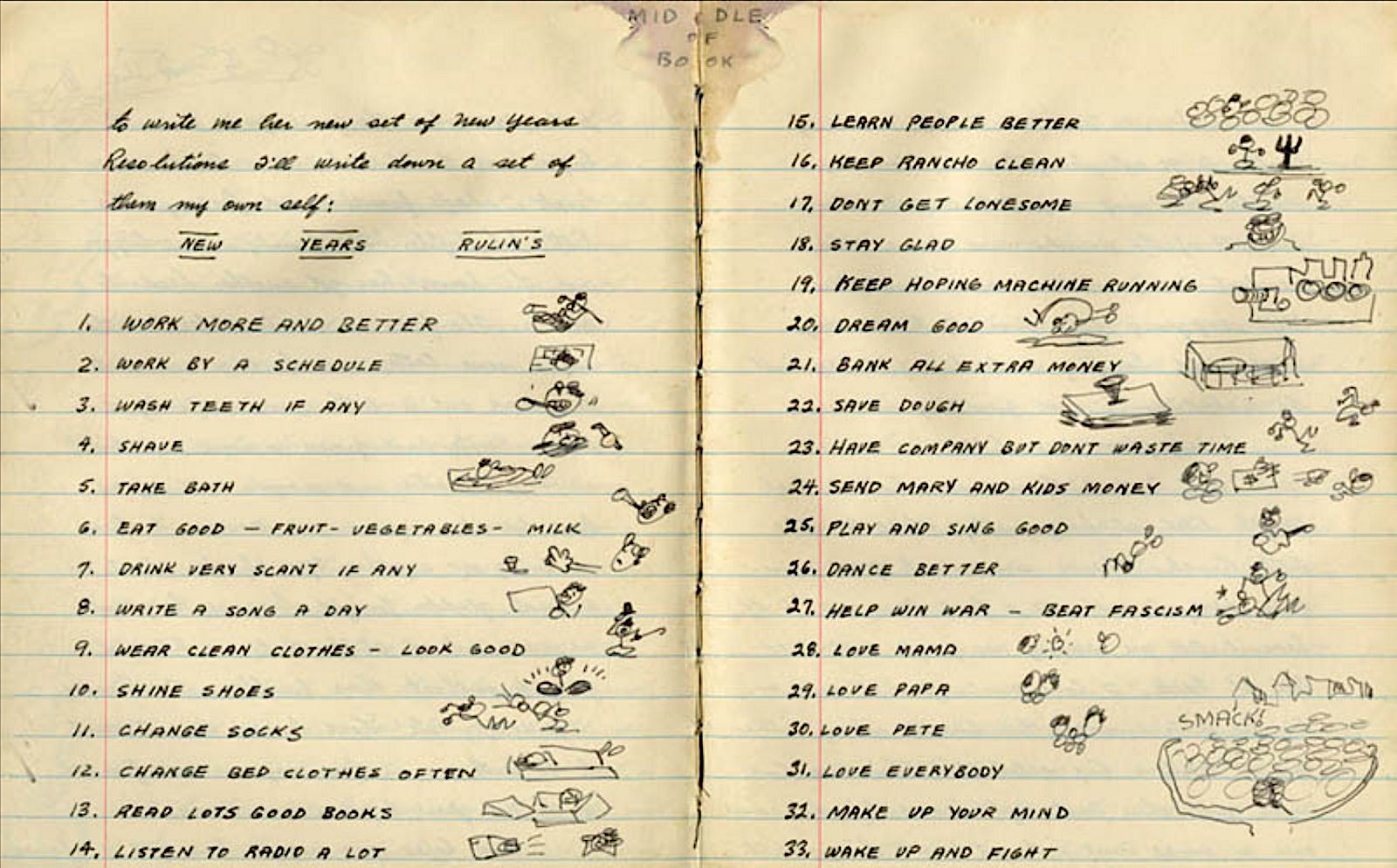
I’m resharing this post from New Year’s Day 2025 because a) it may be new to you and b) Woody’s New Years Rulin’s are forever. Shine your shoes, wash your teeth, beat fascism. Happy 2026.
On January 1, 1943, Woody Guthrie wrote 33 resolutions across the center pages of his notebook. His “New Years Rulin’s” range from the highly specific and practical (“Wash teeth if any”; “Change socks”) to the grandly aspirational (“Beat fascism”; “Love everybody”). Though they’re the product of a particular time and a particular life (“Help win war”; “Send Mary and kids money”) they remain in circulation today. Their folksy charm is hard to resist, but the real reason for their longevity, I think, is their devastating clarity.
Guthrie had many faults and many gifts, and one of his greatest gifts was his ability to say very important things with very few words. He deployed it not only in his more than 3,000 songs but throughout a lifetime of talking and scribbling. Consider Guthrie’s incisive definition of a folk song.:
A folk song is what’s wrong and how to fix it, or it could be whose hungry and where their mouth is, or whose out of work and where the job is or whose broke and where the money is or whose carrying a gun and where the peace is — that’s folk lore and folks made it up because they seen that politicians couldn’t find nothing to fix or nobody to feed or give a job of work.
In 1933, a decade before Guthrie made his New Year’s resolutions, a young German journalist named Charlotte Beradt began to ask her neighbors about their dreams. Like her, she learned, many were plagued by nightmares about surveillance and involuntary complicity; the Nazi propaganda machine had already occupied their unconscious. In a recent New York Review of Books essay about Beradt’s work, Zadie Smith observes that today, “no one need shout at us in a shrill voice through a megaphone” because “we keep the communication channel permanently open in our back pockets.” And so we allow those who control the algorithm to control our dreams.
Beradt fled Germany for New York in 1939. Guthrie, after being fired from a West Coast radio station for his left-wing politics, moved to the city the following year. In June 1943, determined to help beat fascism, Guthrie joined the Merchant Marine, surviving two torpedo attacks while serving meals and washing dishes on military supply ships. He often played and sang for his crewmates, and at one point persuaded at least a dozen of them to help build what he called the Woody Guthrie Anticyclone and Ship Speeder-Upper Aerodynamic Wind Machine out of scrap wood, string, rubber bands, and a discarded propeller. He knew how to keep the hoping machine running.
Today, Guthrie’s gift for clarity is more necessary than ever. Inside what Smith calls our “digitally modified slumber,” we’re all too easily persuaded to abandon our convictions. We need to not only make resolutions but carry them with us, expressed in the shortest, sharpest words we have: Eat good. Stay glad. Dance better. Wake up and fight.
If you’d like something specific to conservation to pair with today’s post, I highly recommend Greg Vandy’s book 26 Songs in 30 Days: Woody Guthrie’s Columbia River Songs, which places Guthrie’s paeans to hydropower in historical and political context (without denying their oversights). If you’d like to read more about the art of saying a great deal in a short time, check out Jillian Hess’ essay about Bob Dylan’s notetaking habits. Happy New Year.
This is great, Michelle, thanks for sharing. In hard times, good people do great things.
Reading The Grapes of Wrath in junior high school was my first life-changing experience of the world. The Diary of Anne Frank came later. So did Desert Solitude, Siddhartha, The Snow Leopard, and The Brothers Karamazov. But Steinbeck was the guy who made me aware and truly educated me. And then Henry Miller graduated me. Woody and Pete and the Beats were the background. There is no conservation, no preservation, no consciousness without justice.