

Words We Need: Greentime
An interview with the author of The Emilys.

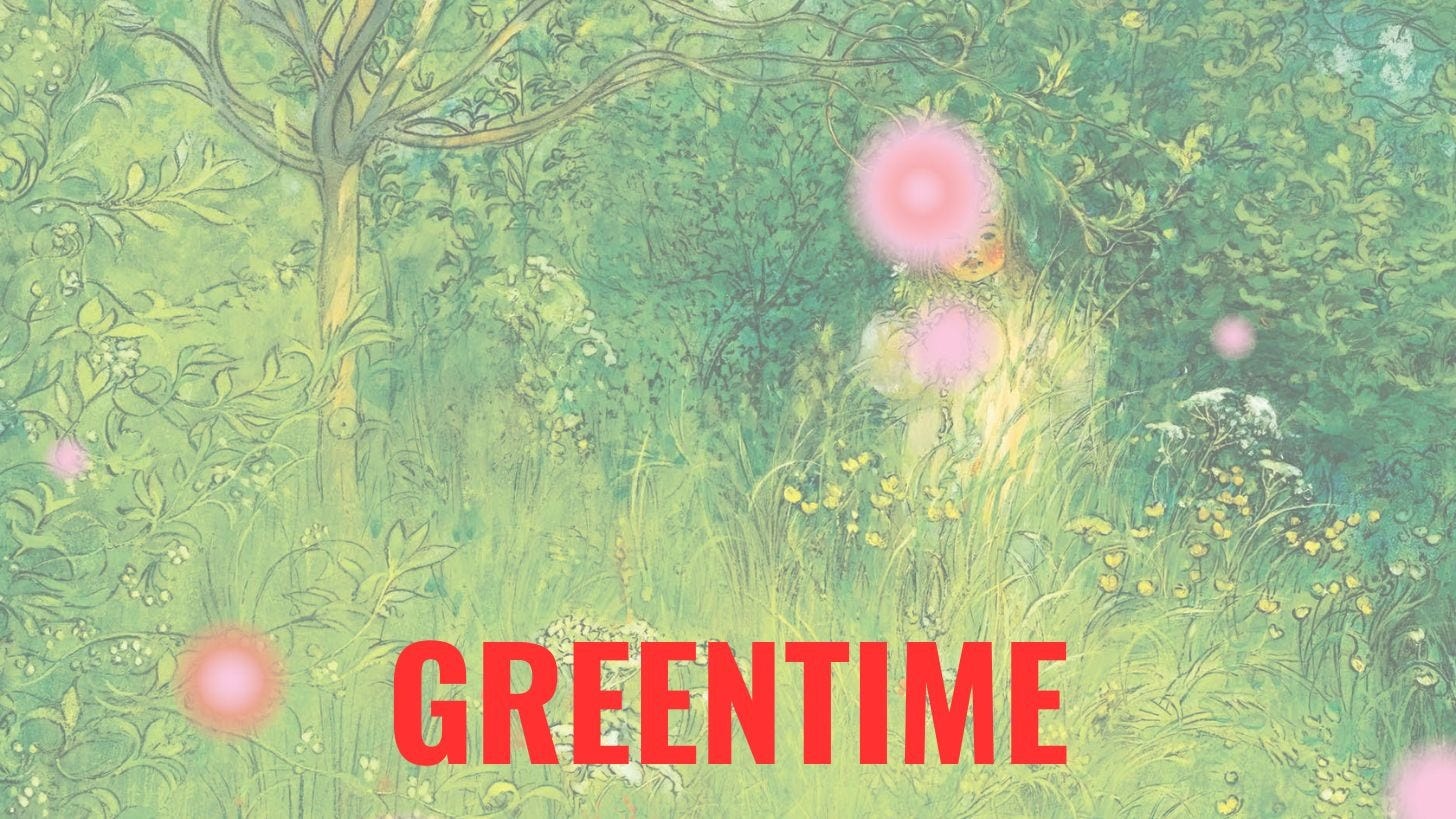
The Emilys, a brand-new novel by my friend Heather Abel, is a terrific read about friendship, parenthood, and art — and the complex ways all three are affected by climate change and habitat loss.
Set in a small town in western Massachusetts, The Emilys begins with reports of a disease that leaves its victims allergic to sunlight, able to go outside only at night. As residents search for answers, they transform their relationships with not only one another but the world around them.
“I wanted to think about how the dangers of climate change are going to affect all of us differently, even within a community — one friend but not another, one person in a family and not another,” Heather told me.
I recently spoke with Heather about The Emilys, the anxieties of parenting in a rapidly changing world, and the inspired state of mind that her characters call “greentime.”
I edited this conversation for length and clarity.
MN: I want to start with “greentime,” which is one of my favorite concepts in The Emilys. Tell us about greentime — what is it, and how and where do you experience it, if you do experience it?
HA: Greentime first comes up in the book when the main character, Eve, remembers the time when she was living in New York and writing fiction. She and her husband, her boyfriend at the time, would have these days of creating, of making something or communing with their art in some way. Then they would go out into the world, and they would feel receptive in a totally new way. Everything they looked at seemed to refer to art — not necessarily their art, but art. Eve would see the structure for a story in the way a building was put together, or she would see a color in a painting and think, “Oh, that’s my character.” She decides to call this feeling “greentime”.
Later on in the book, Eve is with her kids, and she’s not having greentime at all. She has a four-year-old and a nine-year-old, and she’s bored and exhausted. She wants her kids to play in nature, but her kids come from the city and can’t think of a single game to play. So Eve says, “Let’s just lie down. Let’s play the game of lying down.” Her kids say, “No, it has to be a real game,” so she has to come up with a name on the spot, and she says, “Oh, it’s greentime.” Then she immediately regrets it, because that’s the name she’s given to her creative work.
I think I’ve experienced greentime in two ways. One is when I’m in a city, looking at other people and looking at art. If I go to the Whitney Museum and look at the work of Ruth Asawa and Georgia O’Keeffe and then walk into the city, every person is the most beautiful person I’ve ever seen. I’ll be on the subway, and I’ll be full of love for each person and what they’re doing and how they’re getting through their very human day.
The other time I feel it is when I’m totally alone in the woods here in Northampton, which happens almost every day. It’s what got me through the pandemic, and raising teenagers, and writing this book. And I think I was subconsciously connecting the two states of flow, or states of communion, that happen to me either in an urban place or in a place that’s just as crowded but with leaves and birds and bugs. It’s something I can find in only those two places.
MN: I love that because while I was reading, I thought, oh, there’s a connection here between these two kinds of greentime. You’re drawing parallels between the two places where you feel small and art feels big — or inspiration feels big. And that feeds into the central tension in the book, which is that so many of your characters see the natural world as a place of solace or inspiration, but that world becomes a place of danger and fear. What drew you to explore that tension?
HA: Well, I think most people living in the world now feel that tension. I feel it as a parent — the natural world has been my place of solace my whole life, and I wanted my kids to have that, too, so when they were little, I would walk with them in the woods, even as I was reading about climate disasters every day. I was living in their joy, but also holding a certain grief.
A lot of novels about climate change are apocalyptic or post-apocalyptic. This single event happens and makes things unlivable in a way that’s kind of uniform. I started writing this book during the pandemic, which was a single event, but it affected everyone very differently, right? My friends in New York were affected differently than my friends in Massachusetts. And I started thinking about how danger is very particular to regions and places, that danger is as endemic to a place as its ecology and beauty. Whatever happens here in Massachusetts because of climate change will be of here, and I’ll fear it in the same way that I love this place.
I wanted to think about how the dangers of climate change are going to affect all of us differently, even within a community — one friend but not another, one person in a family and not another. That’s going to lead to all these human emotions, of one person wanting to care for another or feeling worried or jealous. And I wanted to put all of those things into a story, because all novels are about relationships and time, right? Relationships plus time equals novel.
MN: Like you say, your exploration of fear is tied to the anxiety of parenting, and the anxiety that all parents face as the climate changes and the world faces more and more crises. How did the experience of writing the book make you think differently about your own parental anxiety?
HA: I had a really loose draft before the pandemic started. And then, because it’s a book about illness, I thought, “Oh, this isn’t going to work — everyone’s understanding of illness is so different now.” So I scrapped it and started again.
I had to imagine a post-pandemic time, because I didn’t want to set it during the pandemic, and that made me think, “Okay, I have to imagine a hopeful ending for this book.” Because my kids, who were 13 and 11 at the time, were, like so many other kids, not in great shape. They were unhappy, and isolated, and scared. So I don’t know if the writing of the book changed my parental anxiety, but it did change my sense of what I wanted to focus on, both in the book and, I guess, in life itself. I wanted to focus on where we come together, where we help each other.
When my kids would say things like, “Climate change is the end,” I had to come up with an answer that wasn’t, you know, “It’s all going to be fine,” because it isn’t. The answer I came to was that nature is amazing and humans are amazing. Humans are part of nature, and all the ways that the world helps itself and we help each other are so fascinating that they can capture your curiosity for your whole life. I wanted them to focus on that.
Honestly, if the pandemic hadn’t happened, I could have had a very different ending and a very different book, maybe a darker book.
MN: That makes me wonder — what do you say to friends and others who may want to have kids, but are torn about it because they don’t want to subject their theoretical children to the effects of climate change?
HA: What I end up saying is that the decision to love someone as a parent is a way of aligning yourself with love. That’s the way we’re gonna get through this, I think — by aligning ourselves with love and believing that people, as we move forward, are going to find more brilliant ways to do that together. I can’t say that it’s going to be easy or that it’s going to be doable, and I don’t think that there’s any time in history that we could say that. But we can say that the impulse to care and love is worth spending our lives following. Caring for children is a lot of labor and a lot of time and energy, and there are few things that are as fascinating as it is.
MN: So I think a lot of people feel that their version of greentime is threatened, even if they don’t put it in those words. How can we continue to find greentime, even as our green places, whatever they might look like, are more dangerous or harder to find?
HA: I think it’s about complicating greentime, right? The greentime that Eve has, and I have, comes from something we can just witness. We witness it, and it feeds us. Like you said, our cities are larger than us, the mountains and forests are larger, and they feed us. I think the new way of having greentime is still going to be about wonder, but it’s also going to be about grief. And for me, I think it’s going to be about other people, because being with other people is so often the way to handle grief. I love just walking into the woods by myself. If someone offers to take a hike with me, I sometimes think, “Why would I want to take a hike with you? It’s my greentime!” But I think the way to manage the grief we have and hold the hope we need will be to have more greentime in person, with other people.
I love that concept, I think it will stay with me