

Words We Need: Murmuration
"A convivial democracy, modeled by birds."

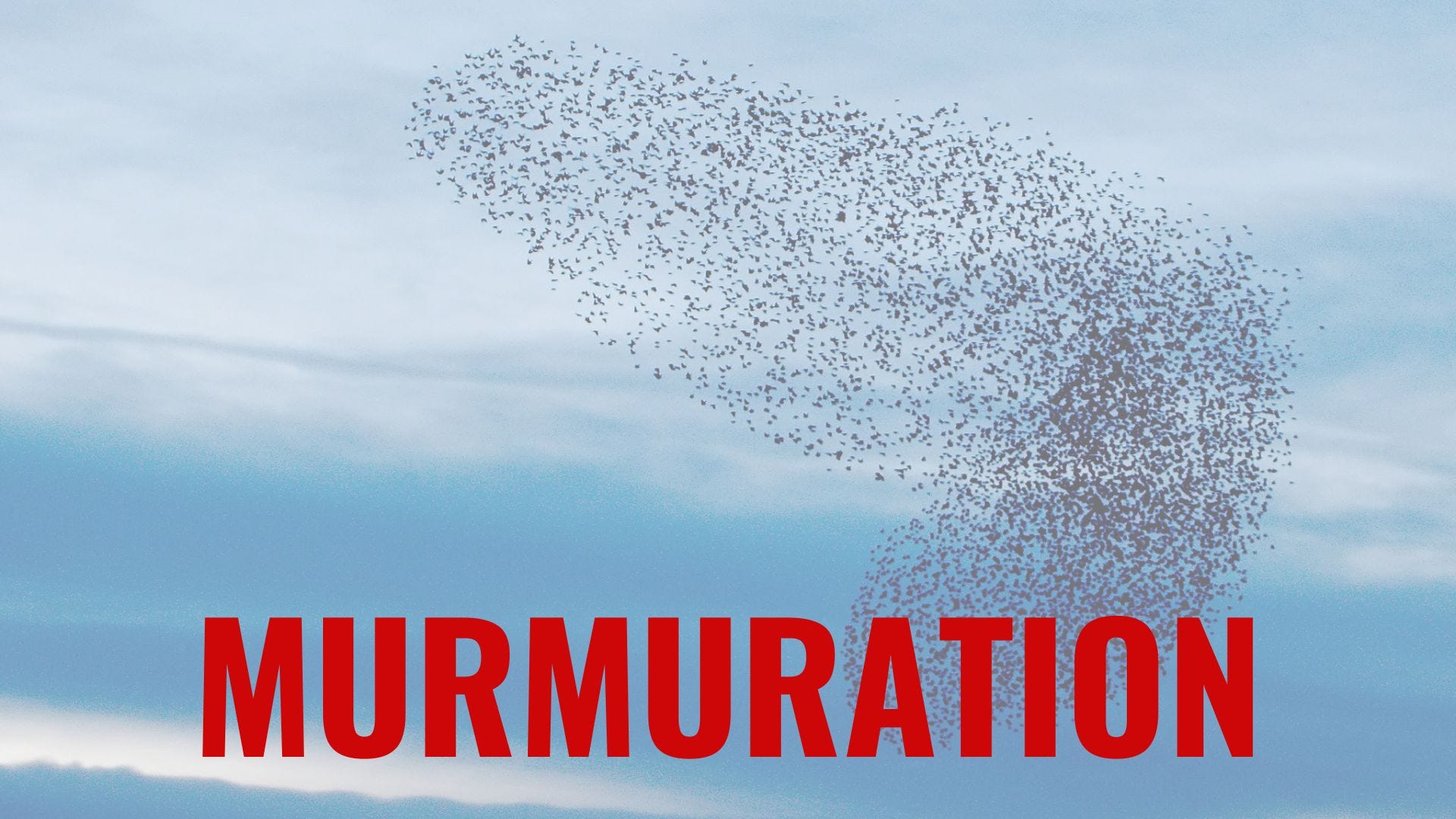
Many birds gather in flocks, but European starlings are famous for their murmurations — clouds of birds that twist and swoop across the sky like pointillist serpents. Starlings achieve this eerie unity by coordinating with their seven closest neighbors and practicing what researchers call “scale-free correlation,” maintaining tight communication even within the largest flocks. Murmuration is thought to be a defense against predators, but it might also be a lot of fun. I mean, doesn’t this look like a blast?
Nicholas Mirzoeff, a professor of media, culture, and communication at New York University, says murmuration is the metaphor our societies need now. “The road to human freedom is a four-dimensional, non-hierarchical convivial democracy, modeled by birds,” he said in a public talk in Portland, Oregon, last week.
Murmurations provide not only safety in numbers but a degree of anonymity, useful when political activists are targeted and cameras are ubiquitous. They are an effective means of migration, allowing escape from persecution and disaster. Leaderless and agile, they can change direction, merge, or disperse in an instant.
Murmurations can also help make sense of chaotic times. Mirzoeff cited the 2021 video installation “Five Murmurations,” by the British-Ghanaian artist John Akomfrah, which used the phenomenon of murmuration to explore the intertwined roots, and effects, of the global pandemic and the murder of George Floyd. “Without presuming to explain the horrors of recent history, he has given them a shape,” one reviewer wrote of Akomfrah.
Almost a thousand years ago, the Persian poet Attār wrote “The Conference of the Birds,” in which the world’s birds set out to find their king. After many trials and internal conflicts, the birds reach the end of their journey, where they find a lake — and, in its water, their own reflections. Like Attār’s birds, Mirzoeff observed, humanity has long histories of endurance, collaboration, and wise self-governance. It’s time for the murmurations to recognize themselves, and reassemble.
Conservation at Work
Mirzoeff’s talk brought to mind the renaming of the Audubon Society, which appears to be happening by murmuration. Public attention on John James Audubon’s history as an enslaver led many organization members and staff to support renaming the organization, but in 2023 the board of the National Audubon Society voted for the status quo. The society’s decentralized structure, however, allows local Audubon chapters to rename themselves — and over the past two years, about 50 of the 400 chapters have done so, with many adopting a variation on “Bird Alliance.” Audubon’s artistic talent transformed the modern conservation movement, but after 120 years, it’s time for the organization (which was founded by his admirers, not the man itself) to adopt a clearer, more welcoming name. That a murmuration of chapters might turn the Audubon Society into an alliance for birds seems especially appropriate.
Your murmuration might draw strength from “sympathetic revenge.”
The California Grizzly Alliance, a group of wildlife advocates, land managers, tribal leaders, and interdisciplinary researchers, has just released Recovering Grizzly Bears in California: A Feasibility Study.
Thank you to Fred Clark of This Land and his co-author Paul Strong for this authoritative and up-to-date overview of the Trump administration’s attacks on U.S. Forest Service personnel and policy.
Bravo to Ethan Freedman of American Avocet and his case for “pro-biodiversity journalism.” Expecting environmental journalists to devote space to arguments against the importance of healthy ecosystems is as ridiculous as expecting reporters on the public safety beat to represent the “pro-crime” constituency.
Finally, David Lukas of Lukas Guides reminds us that lemmings don’t commit mass suicide — and that Disney deserves the blame for making us think they did.
I’ll be at the Society of Environmental Journalists conference in Tempe, Arizona, later this week, moderating panels on biodiversity reporting and public lands as well as joining Gary Nabhan, Lauren Oakes, and Jeff Goodell on the authors’ panel. If you're there, please say hello!
This is so beautiful. I keep reaching for inspiration to lift us into the work. Birds!! Murmurations!! Thank you so much for these observations.
Thanks for this post. I am writing a series of articles called Wild Stories where I explore an animal, plant, landscape, etc. Murmeration is one of this year's topics!