

Words We Need: Sintering
The rewards of bonding with your fellow flakes.

Thanks to Matt Williams for recommending this Word We Need.
This week, two seasonal phenomena returned to my neighborhood. The Cascade Mountains of Washington and Oregon got their first significant snowfall; in response, Jason Lemieux, the manager of the nearby Nordic ski area, restarted his charming predawn Instagram reports on local snow conditions. “Come get it while you can,” he advised after grooming trails this morning. “Temperatures look to be warming up tonight!”
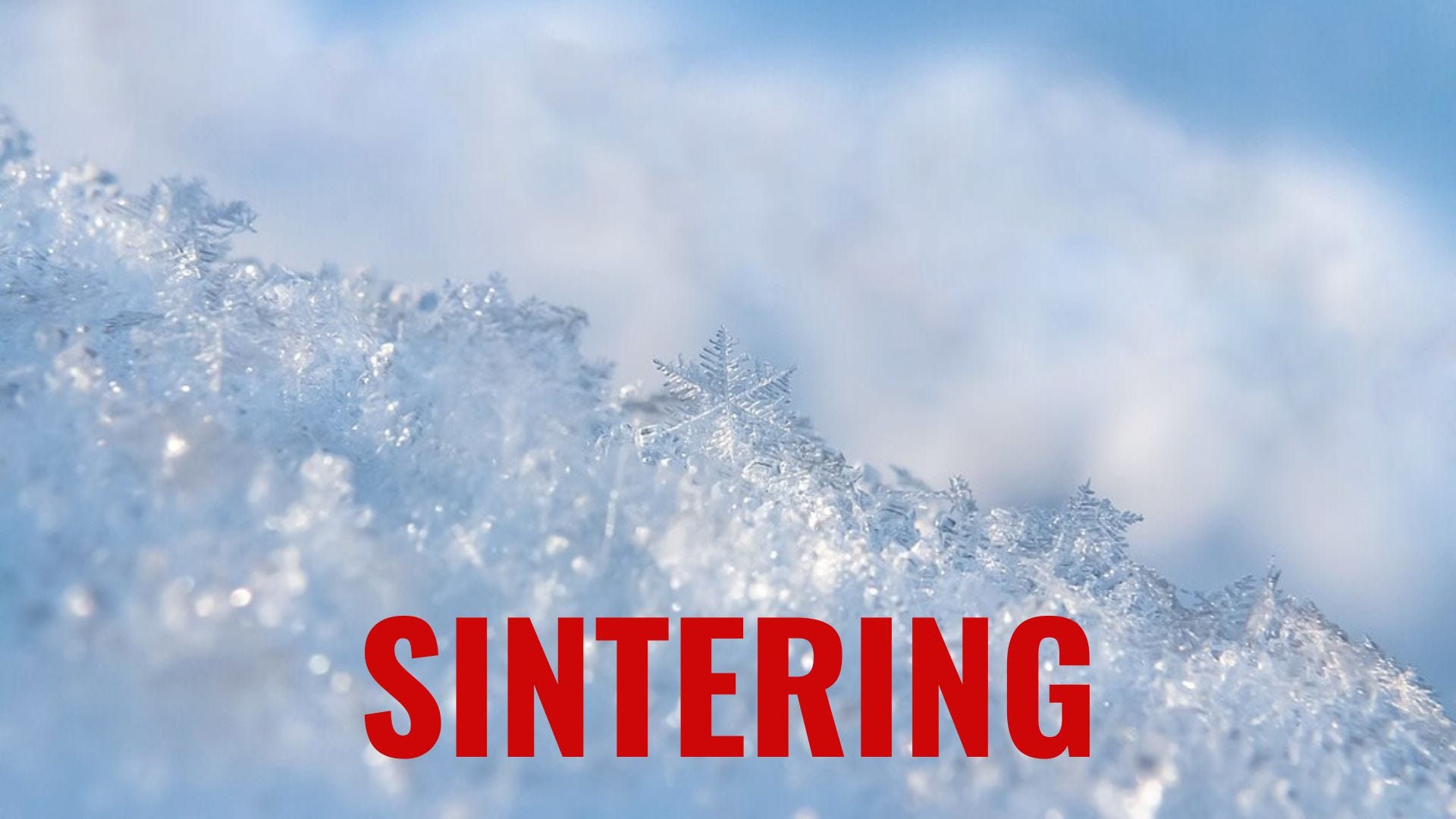
Once snowflakes fall to the ground, they begin a slow process of deformation, rounding off their sharp edges and forming bonds with neighboring flakes. This sintering, as it’s called, creates the dense lattice of crystals that supports Jason’s groomer as he further compacts the snow into slippery trails.
For Leanne Betasamosake Simpson, a lifelong skier and the author of Theory of Water: Nishnaabe Maps to the Times Ahead, sintering provides both the literal foundation of her winters and a metaphor for making change. Several years ago, she volunteered to help groom the trail along Jackson Creek in Peterborough, Ontario, where she skis daily. “I discovered that nearly every day the snow was slightly different,” she writes.
Simpson became fascinated by sintering, and by the idea that “the first thing a snowflake does when it lands from the skyworld is to join bonds, actual physical bonds, with its neighbors.” She observed that these “coalitions” of flakes allowed the packed snow on the trail to linger long after rising temperatures melted the snow around it. She writes:
My ancestors were very good at sintering … at living in a way that bonded them to the different forms of life with whom they were sharing time and space. They were building not a Nishnaabeg world, but a Nishnaabeg coalition, working with plant life, animal life and all the other planetary forces that existed before humans. They sintered and wove themselves into the existing fabric of life, working in concert with the planet to renew themselves.
Sintering is the process of gaining strength through forming bonds, of adapting to one’s neighbors without changing one’s essential shape. Like a sintered snowpack, a sintered coalition of humans can endure far longer than any of its individual components could survive alone. In a sintered coalition of humans and other species, I imagine, there would be constant adaptation and accommodation, but no single species could drive the others to extinction.
Sinter while you can; temperatures look to be warming up tonight.
Conservation at Work
Speaking of forming coalitions, I appreciated this call to “look out not only for neighbors we like but for neighbors we like least,” and this thoughtful investigation of the ever-shifting relationships generically labeled as “community.”
The plains bison, that icon of Western North America, used to roam freely east of the Mississippi, too, and might one day again.
Caribou within the territory of the West Moberly First Nations, in northeastern British Columbia, were declared extirpated by the provincial and Canadian governments more than a decade ago and, as a result, have not been regularly monitored since. Earlier this year, however, a study that combined Indigenous knowledge with remote camera trapping identified 40 individual caribou — the highest count reported since the start of the century. The study’s authors quote West Moberly elder Max Desjarlais: “Walk the land before you talk about the land.”
Riding the land is the focus of another new study, which conducted in-depth interviews with several “range riders” — people hired by ranchers to deter wolves or grizzly bears from livestock by riding near herds, on horse or ATV. The practice of range riding, the authors conclude, can not only protect both livestock and predators but “play a central role in building trust — between environmentalists, agencies, and resource users.” They caution, however, that range-riding programs need long-term economic support.
Finally, Kerry Clare of Pickle Me This recently shared this striking postcard from A Lake Story, a canoe procession that celebrated two decades of hard-won conservation progress on Toronto’s Don River. Enjoy.
"To sinter": I like the sound of it. Also plan to steal "internal stewardship," as mentioned in the reply to Jason Mark.
I find that I increasingly need to hold off reading your newsletter until I have time to not only digest the content, but also follow the links.
You asked for recommendations about books that can help us envision a more "verdant and just world." I'd give a shout out to Jenny Odell's HOW TO DO NOTHING. It's mostly about how to resist the attention economy, and it's also a deep meditation on how to tune in to the other time scales in nature.